
A Hitchhiker’s Guide to Asynchronous Programming#
Abstract#
The C10k problem remains a fundamental challenge for programmers seeking to handle massive concurrent connections efficiently. Traditionally, developers address extensive I/O operations using threads, epoll, or kqueue to prevent software from blocking on expensive operations. However, developing readable and bug-free concurrent code is challenging due to complexities around data sharing and task dependencies. Even powerful tools like Valgrind that help detect deadlocks and race conditions cannot eliminate the time-consuming debugging process as software scales.
To address these challenges, many programming languages—including Python,
JavaScript, and C++—have developed better libraries, frameworks, and syntaxes
to help programmers manage concurrent tasks properly. Rather than focusing on
how to use modern parallel APIs, this article concentrates on the design
philosophy behind asynchronous programming patterns, tracing the evolution
from blocking I/O to the elegant async/await syntax.
Using threads is the most natural approach for dispatching tasks without
blocking the main thread. However, threads introduce performance overhead from
context switching and require careful locking of critical sections for atomic
operations. While event loops can enhance performance in I/O-bound scenarios,
writing readable event-driven code is challenging due to callback complexity
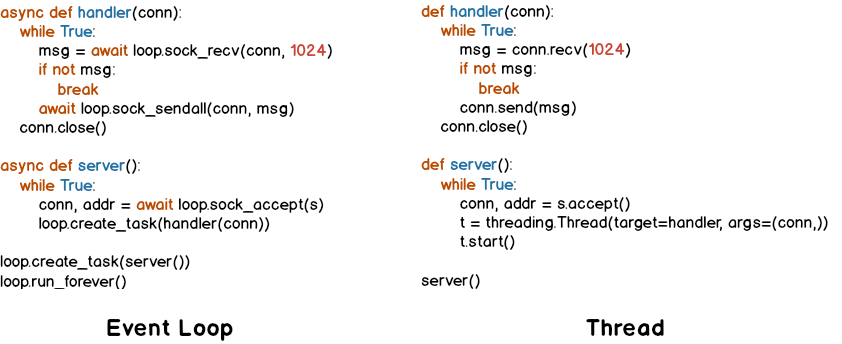
(commonly known as “callback hell”). Fortunately, Python introduced the
async/await syntax to help developers write understandable code with high
performance. The following figure illustrates how async/await enables
handling socket connections with the simplicity of threads but the efficiency
of event loops.
Introduction#
Handling I/O operations such as network connections is among the most expensive tasks in any program. Consider a simple TCP blocking echo server (shown below). If a client connects without sending any data, it blocks all other connections. Even when clients send data promptly, the server cannot handle concurrent requests because it wastes significant time waiting for I/O responses from hardware like network interfaces. Thus, socket programming with concurrency becomes essential for managing high request volumes.
import socket

s = socket.socket(socket.AF_INET, socket.SOCK_STREAM, 0)
s.setsockopt(socket.SOL_SOCKET, socket.SO_REUSEADDR, 1)
s.bind(("127.0.0.1", 5566))
s.listen(10)

while True:
    conn, addr = s.accept()
    msg = conn.recv(1024)
    conn.send(msg)
One solution to prevent blocking is dispatching tasks to separate threads. The following example demonstrates handling connections simultaneously using threads. However, creating numerous threads consumes computing resources without proportional throughput gains. Worse, applications may waste time waiting for locks when processing tasks in critical sections. While threads solve blocking issues, factors like CPU utilization and memory overhead remain critical for solving the C10k problem. Without creating unlimited threads, the event loop provides an alternative solution for managing connections efficiently.
import threading
import socket

s = socket.socket(socket.AF_INET, socket.SOCK_STREAM)
s.setsockopt(socket.SOL_SOCKET, socket.SO_REUSEADDR, 1)
s.bind(("127.0.0.1", 5566))
s.listen(10240)

def handler(conn):
    while True:
        msg = conn.recv(65535)
        conn.send(msg)

while True:
    conn, addr = s.accept()
    t = threading.Thread(target=handler, args=(conn,))
    t.start()
A simple event-driven socket server comprises three main components: an I/O
multiplexing module (e.g., select), a scheduler (the loop), and
callback functions (event handlers). The following server uses Python’s
high-level I/O multiplexing module, selectors, within a loop to check
whether I/O operations are ready. When data becomes available for reading or
writing, the loop retrieves I/O events and executes the appropriate callback
functions—accept, read, or write—to complete tasks.
import socket
from selectors import DefaultSelector, EVENT_READ, EVENT_WRITE
from functools import partial

s = socket.socket(socket.AF_INET, socket.SOCK_STREAM)
s.setsockopt(socket.SOL_SOCKET, socket.SO_REUSEADDR, 1)
s.bind(("127.0.0.1", 5566))
s.listen(10240)
s.setblocking(False)

sel = DefaultSelector()

def accept(s, mask):
    conn, addr = s.accept()
    conn.setblocking(False)
    sel.register(conn, EVENT_READ, read)

def read(conn, mask):
    msg = conn.recv(65535)
    if not msg:
        sel.unregister(conn)
        return conn.close()
    sel.modify(conn, EVENT_WRITE, partial(write, msg=msg))

def write(conn, mask, msg=None):
    if msg:
        conn.send(msg)
    sel.modify(conn, EVENT_READ, read)

sel.register(s, EVENT_READ, accept)
while True:
    events = sel.select()
    for e, m in events:
        cb = e.data
        cb(e.fileobj, m)
Although managing connections via threads may be inefficient, event-loop-based programs are harder to read and maintain. To enhance code readability, many programming languages—including Python—introduce abstract concepts such as coroutines, futures, and async/await to handle I/O multiplexing elegantly. The following sections explore these concepts and the problems they solve.
Callback Functions#
Callback functions control data flow at runtime when events occur. However, preserving state across callbacks is challenging. For example, implementing a handshake protocol over TCP requires storing previous state somewhere accessible to subsequent callbacks.
import socket
from selectors import DefaultSelector, EVENT_READ, EVENT_WRITE
from functools import partial

s = socket.socket(socket.AF_INET, socket.SOCK_STREAM)
s.setsockopt(socket.SOL_SOCKET, socket.SO_REUSEADDR, 1)
s.bind(("127.0.0.1", 5566))
s.listen(10240)
s.setblocking(False)

sel = DefaultSelector()
is_hello = {}

def accept(s, mask):
    conn, addr = s.accept()
    conn.setblocking(False)
    is_hello[conn] = False
    sel.register(conn, EVENT_READ, read)

def read(conn, mask):
    msg = conn.recv(65535)
    if not msg:
        sel.unregister(conn)
        return conn.close()

    # Check whether handshake is successful
    if is_hello[conn]:
        sel.modify(conn, EVENT_WRITE, partial(write, msg=msg))
        return

    # Perform handshake
    if msg.decode("utf-8").strip() != "hello":
        sel.unregister(conn)
        return conn.close()

    is_hello[conn] = True

def write(conn, mask, msg=None):
    if msg:
        conn.send(msg)
    sel.modify(conn, EVENT_READ, read)

sel.register(s, EVENT_READ, accept)
while True:
    events = sel.select()
    for e, m in events:
        cb = e.data
        cb(e.fileobj, m)
Although the is_hello dictionary stores state to track handshake status,
the code becomes difficult to understand. The underlying logic is actually
simple—equivalent to this blocking version:
def accept(s):
    conn, addr = s.accept()
    success = handshake(conn)
    if not success:
        conn.close()

def handshake(conn):
    data = conn.recv(65535)
    if not data:
        return False
    if data.decode('utf-8').strip() != "hello":
        return False
    conn.send(b"hello")
    return True
To achieve similar structure in non-blocking code, a function (or task) must
snapshot its current state—including arguments, local variables, and execution
position—when waiting for I/O operations. The scheduler must then be able to
re-enter the function and execute remaining code after I/O completes.
Unlike languages like C++, Python achieves this naturally because generators
preserve all state and can be re-entered by calling next(). By utilizing
generators, handling I/O operations in a non-blocking manner with readable,
linear code—called inline callbacks—becomes possible within an event loop.
Event Loop#
An event loop is a user-space scheduler that manages tasks within a program instead of relying on operating system thread scheduling. The following snippet demonstrates a simple event loop handling socket connections asynchronously. The implementation appends tasks to a FIFO job queue and registers with a selector when I/O operations are not ready. A generator preserves task state, allowing execution to resume without callback functions when I/O results become available. Understanding how this event loop works reveals that a Python generator is indeed a form of coroutine.
# loop.py

from selectors import DefaultSelector, EVENT_READ, EVENT_WRITE

class Loop:
    def __init__(self):
        self.sel = DefaultSelector()
        self.queue = []

    def create_task(self, task):
        self.queue.append(task)

    def polling(self):
        for e, m in self.sel.select(0):
            self.queue.append((e.data, None))
            self.sel.unregister(e.fileobj)

    def is_registered(self, fileobj):
        try:
            self.sel.get_key(fileobj)
        except KeyError:
            return False
        return True

    def register(self, t, data):
        if not data:
            return False

        event_type, fileobj = data
        if event_type in (EVENT_READ, EVENT_WRITE):
            if self.is_registered(fileobj):
                self.sel.modify(fileobj, event_type, t)
            else:
                self.sel.register(fileobj, event_type, t)
            return True
        return False

    def accept(self, s):
        while True:
            try:
                conn, addr = s.accept()
            except BlockingIOError:
                yield (EVENT_READ, s)
            else:
                break
        return conn, addr

    def recv(self, conn, size):
        while True:
            try:
                msg = conn.recv(size)
            except BlockingIOError:
                yield (EVENT_READ, conn)
            else:
                break
        return msg

    def send(self, conn, msg):
        while True:
            try:
                size = conn.send(msg)
            except BlockingIOError:
                yield (EVENT_WRITE, conn)
            else:
                break
        return size

    def once(self):
        self.polling()
        unfinished = []
        for t, data in self.queue:
            try:
                data = t.send(data)
            except StopIteration:
                continue

            if self.register(t, data):
                unfinished.append((t, None))

        self.queue = unfinished

    def run(self):
        while self.queue or self.sel.get_map():
            self.once()
By assigning jobs to an event loop, the programming pattern resembles using
threads but with a user-level scheduler. PEP 380 introduced generator
delegation via yield from, allowing a generator to wait for other generators
to complete. The following snippet is far more intuitive and readable than
callback-based I/O handling:
# server.py
# $ python3 server.py &
# $ nc localhost 5566

import socket
from loop import Loop

s = socket.socket(socket.AF_INET, socket.SOCK_STREAM)
s.setsockopt(socket.SOL_SOCKET, socket.SO_REUSEADDR, 1)
s.bind(("127.0.0.1", 5566))
s.listen(10240)
s.setblocking(False)

loop = Loop()

def handler(conn):
    while True:
        msg = yield from loop.recv(conn, 1024)
        if not msg:
            conn.close()
            break
        yield from loop.send(conn, msg)

def main():
    while True:
        conn, addr = yield from loop.accept(s)
        conn.setblocking(False)
        loop.create_task((handler(conn), None))

loop.create_task((main(), None))
loop.run()
Using an event loop with yield from manages connections without blocking
the main thread—this was how asyncio worked before Python 3.5. However,
yield from is ambiguous: why does adding @asyncio.coroutine transform
a generator into a coroutine? Instead of overloading generator syntax for
asynchronous operations, PEP 492 proposed that coroutines should become a
standalone concept in Python. This led to the introduction of async/await
syntax, dramatically improving readability for asynchronous programming.
What is a Coroutine?#
Python documentation defines coroutines as “a generalized form of subroutines.” This definition, while technically accurate, can be confusing. Based on our discussion, an event loop schedules generators to perform specific tasks—similar to how an OS dispatches jobs to threads. In this context, generators serve as “routine workers.” A coroutine is simply a task scheduled by an event loop within a program, rather than by the operating system.
The following snippet illustrates what @coroutine does. This decorator
transforms a function into a generator function and wraps it with
types.coroutine for backward compatibility:
import asyncio
import inspect
import types
from functools import wraps
from asyncio.futures import Future

def coroutine(func):
    """Simple prototype of coroutine decorator"""
    if inspect.isgeneratorfunction(func):
        return types.coroutine(func)

    @wraps(func)
    def coro(*a, **k):
        res = func(*a, **k)
        if isinstance(res, Future) or inspect.isgenerator(res):
            res = yield from res
        return res
    return types.coroutine(coro)

@coroutine
def foo():
    yield from asyncio.sleep(1)
    print("Hello Foo")

loop = asyncio.get_event_loop()
loop.run_until_complete(loop.create_task(foo()))
loop.close()
With Python 3.5+, the async def syntax creates native coroutines directly,
and await replaces yield from for suspending execution. This makes the
intent explicit: async def declares a coroutine, and await marks
suspension points where the event loop can switch to other tasks.
Conclusion#
Asynchronous programming via event loops has become more straightforward and
readable thanks to modern syntax and library support. Most programming
languages, including Python, implement libraries that manage task scheduling
through integration with new syntaxes. While async/await may seem enigmatic
initially, it provides a way for programmers to develop logical, linear code
structure—similar to using threads—while gaining the performance benefits of
event-driven I/O.
Without callback functions passing state between handlers, programmers no
longer need to worry about preserving local variables and arguments across
asynchronous boundaries. This allows developers to focus on application logic
rather than spending time troubleshooting concurrency issues. The evolution
from callbacks to generators to async/await represents a significant
advancement in making concurrent programming accessible and maintainable.